Inside the Machine: How AI Robot Toys Actually Work
By Curio Team
"AI toy" is the broad category: any toy built to sense and respond to a child using artificial intelligence, usually through conversation, though how much of that intelligence is genuinely learned rather than simply programmed varies a lot from product to product. An AI robot toy is a specific kind of AI toy, one that adds a physical layer on top: it doesn't just think about what you said; it does something about it in the real world. Every AI robot toy is an AI toy, at least by name. Not every AI toy is a robot, and as you'll see, not every "AI robot toy" is as artificially intelligent as its packaging suggests.
This post is about that subset specifically: the AI toys that also move under their own AI logic, and the hardware that lets them act instead of just respond.
What Actually Makes an AI Toy a “Robot”
Robotics engineers generally describe robots as running a loop with three stages: sense, think, act.
- Sense: the toy gathers information about the world through sensors such as cameras, microphones, touch pads, infrared or ultrasonic distance sensors, and accelerometers.
- Think: a processor interprets that information, whether through a simple rule ("if something is within 2 inches, stop") or a trained model deciding how to respond.
- Act: the toy does something physical in response, using motors, wheels, or servos to move, gesture, or reposition itself.
A toy that completes the first two steps, sensing your voice and generating a thoughtful reply, is already a full AI toy on its own. Add the third step, acting on that decision through motors or actuators, and it becomes an AI robot toy too. A talking plush that has a rich, evolving conversation with a child is a great example of an AI toy in its own right. A companion on four legs that walks over, nudges your hand, and adjusts its path around a coffee table is also an AI toy, but one with a physical layer built on top: an AI robot toy. The robot version isn't a different product category so much as the same conversational foundation with motors and sensors layered on.
That distinction matters for parents and shoppers too, not just engineers. Knowing whether an AI toy is also a robot tells you what you're actually getting. A conversation-only AI toy is generally built to maximize language quality and personalization, often without the extra cost, weight, and battery drain of motors. An AI robot toy adds sensors and actuators on top of that same foundation, which usually means more moving parts and different tradeoffs around battery life and durability, in exchange for a toy that can physically respond to you.
With that in mind, here's the hardware every AI robot toy is built from, and then the most common ways manufacturers put it to use.
The Shared Hardware Nearly All AI Robot Toys Have
Every category below is a different combination of the same core parts
- Sensors: the toy's senses, including touch pads, microphones, cameras, infrared or ultrasonic proximity sensors, accelerometers, and gyroscopes.
- A processor or microcontroller: the layer that makes decisions, ranging from simple rules to a chip running a lightweight machine learning model.
- Actuators: motors and servos that turn decisions into motion, driving wheels, legs, arms, heads, or wings.
- Connectivity: Wi-Fi or Bluetooth, used when heavier thinking is offloaded to the cloud.
- Power management: battery systems balanced across sensing, computing, and movement, which draws more power than either of the other two.
That last point is worth pausing on: motors draw far more power than a speaker or a microphone ever will, which is exactly why AI robot toys tend to have shorter battery life and beefier charging docks than a conversation-only AI toy. Physically acting on the world is expensive, computationally and electrically. It's also exactly what separates the robot subset from the wider AI toy category.
The parts list above is nearly identical across every AI robot toy on the market. Where they actually differ is how much of that list is genuine AI, a trained model that learns or reasons, versus classical programmed logic that just follows fixed rules. That split varies a lot by type. Here are the five most common categories, ranked from the one that leans on real AI the most to the one that leans on it the least.
Common Types of AI Robot Toys
Companion Robots
Companion robots depend on real AI more than anything else on this list. Holding an open-ended conversation requires a trained language model, not a fixed set of rules, and many of them add a trained system for emotion or face recognition on top. They add a physical layer to that same conversational foundation, aiming to feel like a presence rather than a device. The conversational side, listening, understanding, and replying, is shared with any AI toy. What makes this one a robot is the physical responsiveness layered on top: motors that turn its head to track your face, animate small gestures, or shift its posture to seem attentive. That's what turns a talking device into something that feels like it's actually paying attention to you.
Robotic Pets
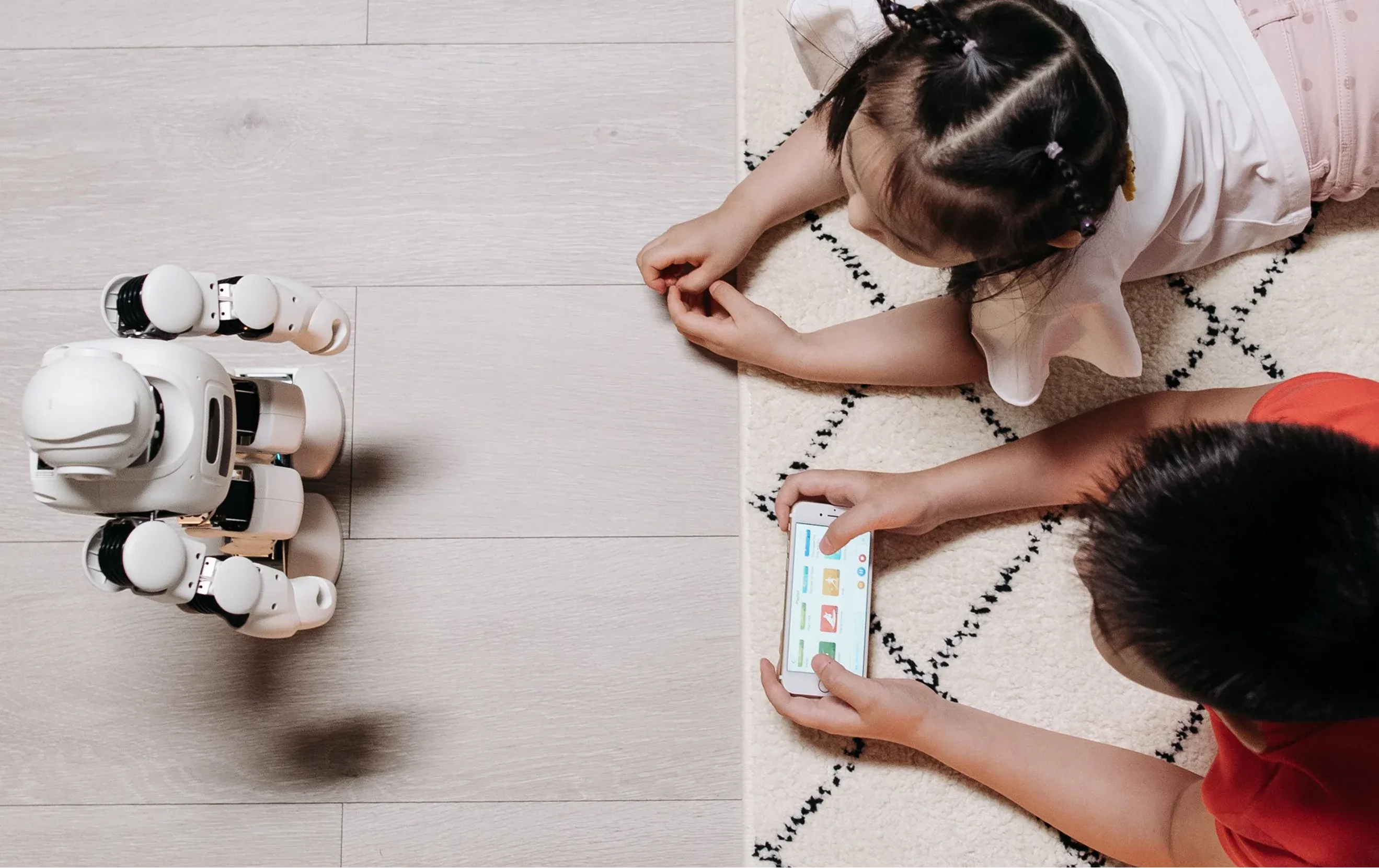
Robotic pets sit a step down the AI scale from companion robots. Higher-end models run genuinely trained behavior models that adapt the more you interact with them, but plenty of robotic pets skip that entirely and run on simple triggered rules instead: "if touched here, wag tail" needs no learning at all. Either way, they're the clearest physical example of the sense, think, act loop, built to imitate the movement of a real animal. What sets them apart is how many motors coordinate at once, often a dozen or more, moving legs, tail, ears, and head together for motion that reads as animal-like rather than the jerk of a single joint. Pet its head and the loop closes instantly: a sensed touch becomes "affectionate contact," which triggers a tail wag or a lean into your hand. Higher-end models go further, using navigation sensors to find their own way around furniture or back to a charging dock without any input from you.
Modular STEM Robotics Kits
Most STEM kits run on programmed logic rather than AI, but they're the one category here where a child can add real machine learning as a deliberate feature: some kits let a child train a simple image classifier on the robot's own camera, turning "think" into something they can watch happen rather than a black box. Outside of that optional add-on, these kits hand a child the individual pieces of the sense, think, act loop and let them build their own robot. What makes them different from everything else on this list is that nothing is fixed: the same controller brick might drive a wheeled rover one week and a robotic arm the next, with the child deciding which sensors feed which actuators.
Autonomous Toy Drones
Drone flight is mostly classical control engineering, not AI. An inertial measurement unit tracks tilt, rotation, and acceleration continuously, feeding the drone's flight stabilization software, which recalculates motor speeds dozens of times a second to keep it level using math that predates the term "AI" by decades. The overall loop is still the fastest on this list, running dozens of cycles per second just to stay airborne. "Follow me" features work on the same simple footing, usually tracking a specific color or shape rather than recognizing a person, since real recognition takes more processing power than the hardware inside a toy can handle in real time.
Educational Coding Robots
Of everything on this list, coding robots rely on AI the least. When a robot executes a child's own written code, like "move forward, turn left, repeat," that's programming, not AI, and even a robot's line-following behavior is usually simple sensor thresholding rather than a trained model. What these robots are actually built for is precision: wheel encoders track exactly how far and how accurately the robot has moved, so a child's code translates into real wheel rotations that closely match what they wrote. The whole loop typically runs on the robot's own microcontroller, with no cloud and no trained model involved.
Conclusion: TL;DR
"AI toy" is the broad category: anything that uses AI to sense and respond, usually through conversation. "AI robot toy" is the subset that also acts on what it senses, moving instead of just replying. Companion robots and higher-end robotic pets usually earn that "AI" half honestly, running on trained models. Coding robots, STEM kits, and drones mostly earn only the "robot" half, built on classical engineering that predates AI as a buzzword, and that's not a knock on them: a coding robot without real AI can still be a great coding robot. Before buying one, ask what's actually doing the thinking, a trained model or fixed rules with an AI sticker on the box. That's what makes the label worth something.