What a Robot Toy Can't Replace: Real Friends, Real Pets, and Real Connection
By Curio Team
An AI companion can hold a real conversation and even remember details a kid tells it. So parents might raise a question: can kids replace a real friendship with a robot toy? It's a good question, and in recent years there's been some real data on it. The short answer is no, AI toys cannot replace a real friendship. To back up that answer, we're going into two studies, one on a robot dog versus a real dog, and one on teens and AI companions.
Robot Pets vs Real Pets: What the Research Actually Shows
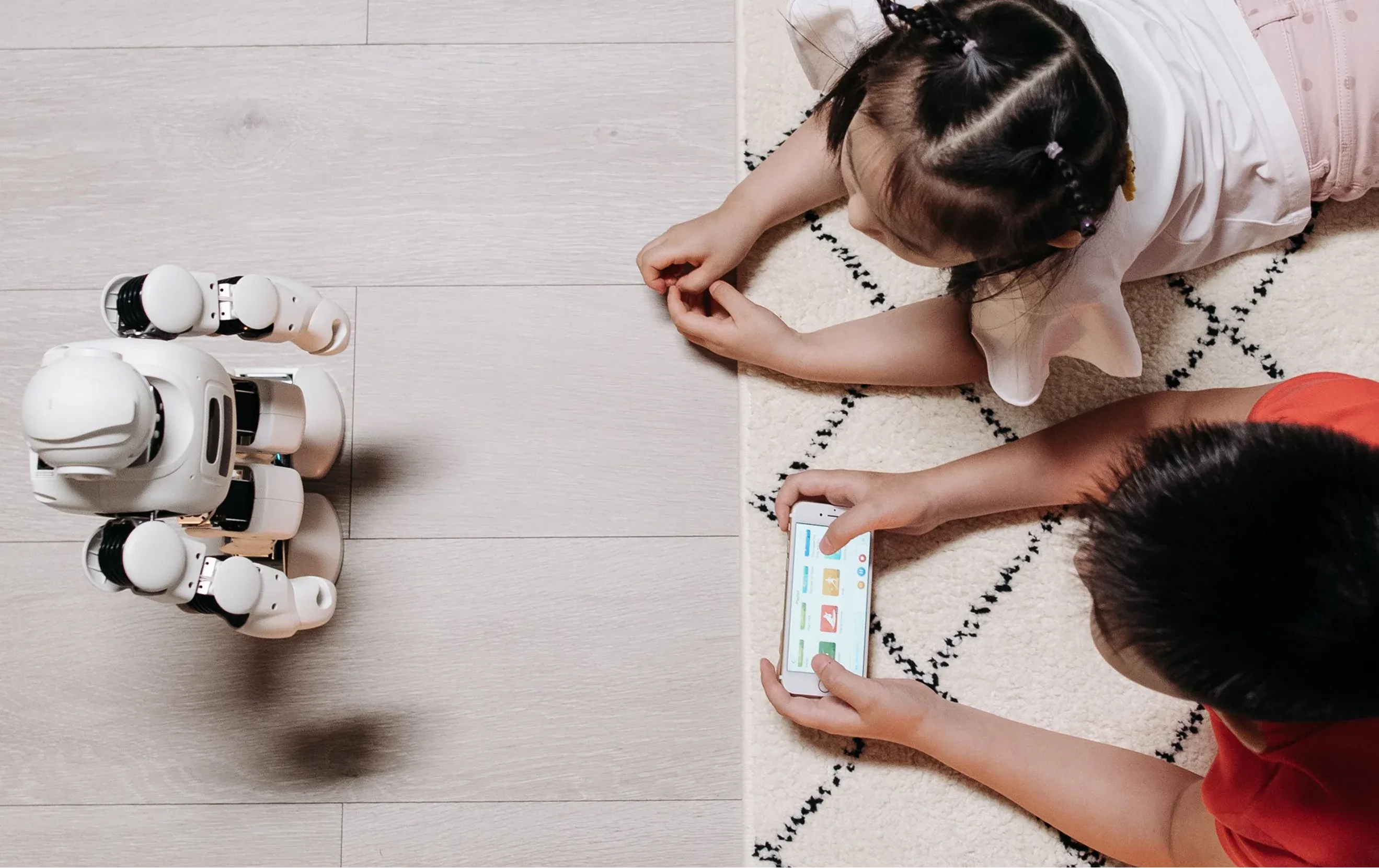
One 2025 study is the best fit for this article, since it compares a robotic dog to a real dog and how each affects humans. Researchers measured this by testing oxytocin levels, sometimes called the love hormone because of its role in trust and bonding, while participants interacted with the robot dog versus the real dog. There were 19 participants, and they went through two separate one-month phases, one with a real dog and one with AIBO. Each month, participants were given detailed instructions on what to do with each dog. After every session, researchers measured oxytocin levels through a urine sample, and participants also filled out an attachment survey afterward.
The results were clear. Oxytocin rose during sessions with the real dog and dropped during sessions with the robotic one. Participants also reported feeling more attached to the real dog and rated it higher as a companion.
What makes this study stronger than most is that it isn't relying on self-reporting alone, the oxytocin measurement gives it a biological data point alongside what people said they felt, and both pointed in the same direction. The honest limitation is that it only tested adults, not children. It's reasonable to assume oxytocin plays a similar role in bonding for kids, since the hormone itself works the same way across ages, but the study doesn't actually tell us whether a child's attachment to a robot dog versus a real one would look the same. Bottom line, a robotic pet can still be low maintenance and genuinely fun for a kid to have. It just probably won't build the same bond a real dog would, and that's fine, a robotic dog doesn't need to fill the spot of a real one.
Robot Toys vs Real Friends: Where the Line Gets Serious
For the human-to-human side of this, the data comes from a 2025 Common Sense Media report on teens and AI chatbots. To be fair, this is about AI chatbots, not robot toys, but it's still useful to bring up since it's in the same general area of non-human emotional connection. It surveyed teens from 13 to 17, which isn't the demographic for robot toys, but it's the closest real data we have.
The findings were notable. Over 72% of teens in the US have used an AI companion, and 52% use it regularly, meaning multiple times a month. The most active users are in the 13% range, who use it daily. A third of the teens in the survey said they've chosen to talk to an AI companion instead of a real person about something serious. Based on that research, Common Sense Media's own recommendation is that nobody under 18 use these AI companion apps at all.
The teens also said some other things that paint a fuller picture. Nearly half reported that they see it more as a tool than an actual relationship. 80% said they still prioritize human friendships, though younger teens seemed more receptive to AI chatbots than older teens did. The researchers read that as a gap in AI literacy among younger teens, not necessarily a sign they're more emotionally vulnerable. The majority of teens surveyed are not using this to replace real friendships, which is a fair silver lining.
Warning Signs to Watch For With a Robot Toy
Neither of these studies was conducted with younger children, so this section is less about hard data and more about applying what the research suggests. There's an important distinction between a favorite toy and a toy your kid treats like a friend. It's worth watching how that relationship actually plays out, and whether your kid has any trouble adjusting to or accepting that the toy isn't a real substitute. Here are some things to look out for:
- Does your kid still ask to see friends or the family pet as much as before the toy arrived, or has that dropped off?
- When your kid is upset, are they reaching for the toy first, or still reaching for a person?
- Does the toy come out during downtime and get put away like any other toy, or has it become the default company for most of the day?
- If the toy disappeared tomorrow, would your kid be mildly annoyed, or genuinely distressed in a way that feels closer to losing a friend?
Most important to pay attention to are the conversations your child has with their toy, and the type of relationship they seem to have with it.
Conclusion
Robot toys aren't bad. They're just not a substitute for the real thing. A robot toy can be more patient than any person manages to be on a rough day, but it isn't capable of actually caring back, and that's the difference that matters.
The signal to watch for isn't whether your kid likes their robot toy. It's whether they start reaching for it instead of a friend, a parent, or the family dog, rather than alongside them. That's the point where a fun toy has quietly started doing a job the research says it isn't built to do.
Sources:
Title: "Social bonding between humans, animals, and robots: Dogs outperform AIBOs, their robotic replicas, as social companions" Authors: Stella Klumpe, Kelsey C. Mitchell, Emma Cox, Jeffrey S. Katz, Lucia Lazarowski, Gopikrishna Deshpande, Jonathan Gratch, Ewart J. de Visser, Hasan Ayaz, Xingnan Li, Adrian A. Franke, Frank Krueger Source: PLOS One, Vol. 20, No. 6, e0324312, published June 3, 2025 DOI: https://doi.org/10.1371/journal.pone.0324312 Institution: School of Systems Biology, George Mason University (Fairfax, VA)
Title: "Talk, Trust, and Trade-Offs: How and Why Teens Use AI Companions" Authors: Michael B. Robb, Supreet Mann Source: Common Sense Media, published July 16, 2025 DOI: No DOI assigned Institution: Common Sense Media (San Francisco, CA)